
Table of Contents
A Quick Introduction

Product Manager with 8+ years of experience, specializing in growth and monetization with quick impact delivery.
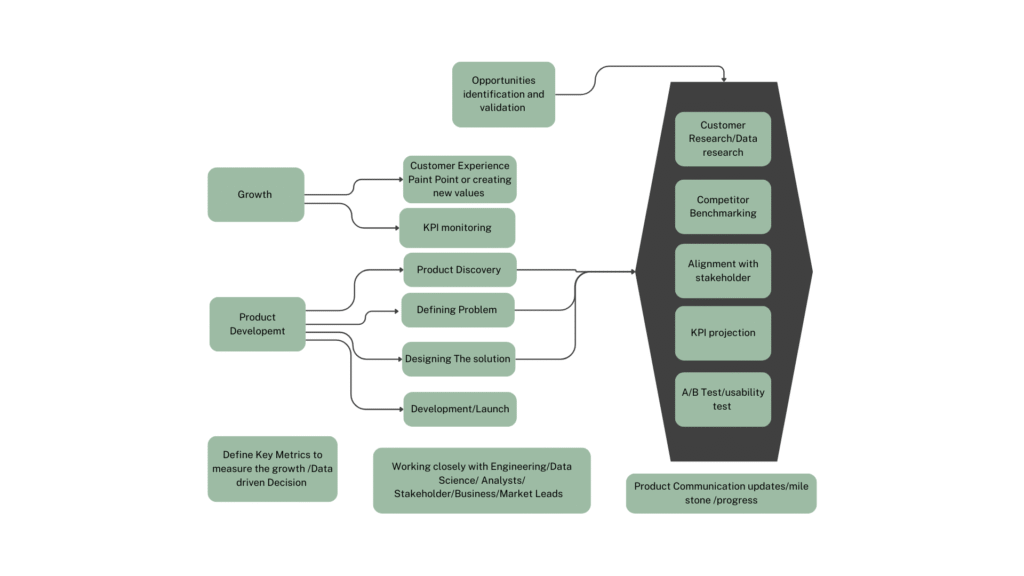
Proven expertise in leading product discovery to identify and prioritize high-value opportunities.
Skilled in conducting customer research, competitive benchmarking, and aligning with business strategy and stakeholder needs.
Experienced in defining product problems and validating opportunities using North Star metrics, supporting KPIs, and projected impact analysis.
Proficient in running A/B tests, usability testing, and rapid iterations to reduce risk and validate solutions.
Strong track record of collaborating with engineering, data scientists, analysts, and cross-functional teams to ship scalable products.
Expert in optimizing CAC, improving customer experience, driving CLV growth, and increasing retention and engagement through data-led product strategies.
Excellent communicator with experience in delivering strategic product updates to C-level executives, stakeholders, and business leaders.
Focused on driving measurable outcomes through data-informed decision-making, experimentation, and tight execution loops.
Indranil’s Product Strategy Framework: Growth Through Discovery
B2C Projects
As Is
To Be
Launching BAUHAUS’s First Native E-commerce App: A Discovery-Driven Approach
Situation
Task
Action
Result
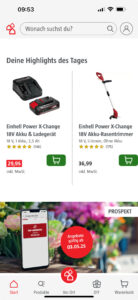
BAUHAUS had a strong offline presence but lacked a native e-commerce app, missing out on mobile-first customers and digital growth opportunities. I was brought in to lead the launch of their first mobile shopping app from scratch—aligning business needs, user expectations, and technical feasibility.
My task was to lead the end-to-end launch of BAUHAUS’s first native e-commerce app. This involved multiple structured phases:
Setting clear product goals aligned with business strategy and digital growth expectations.
Conducting customer surveys and 1:1 interviews to uncover user needs, pain points, and shopping behavior.
Identifying key stakeholders across engineering, retail operations, logistics, marketing, and customer support.
Defining the initial app feature set based on customer input, operational feasibility, and cross-functional alignment.
Benchmarking competitor apps and industry standards to ensure we delivered a competitive and intuitive experience.
Defining success KPIs, including app conversion rate, onboarding completion, and 30-day retention.
Planning the MVP launch, including release milestones, internal testing, and go-to-market coordination.
- Conducted customer discovery via targeted surveys and 1:1 interviews with existing retail customers to uncover pain points, expectations, and mobile shopping behaviors.
Framed the opportunity through internal alignment sessions and Design Thinking workshops to understand business goals and surface assumptions.
Mapped the problem space by synthesizing research insights into user personas and key jobs-to-be-done.
Benchmarked competitor apps to identify UX gaps, feature expectations, and opportunities for differentiation.
Defined initial hypotheses and MVP scope collaboratively with design, engineering, and business teams—focused on high-impact, low-complexity features like personalized bundles, cart, and checkout.
Validated key assumptions through low-fidelity prototypes and usability tests to ensure desirability and ease of use.
Identified KPIs and success metrics (e.g., app conversion rate, onboarding completion, repeat engagement) with analysts to quantify impact and guide decisions.
Prioritized delivery in iterative sprints based on evidence and learning velocity, then collaborated closely with engineering to move into development.
Set up feedback loops post-launch to continuously monitor adoption, user behavior, and improvement areas.
Successfully launched BAUHAUS’s first native e-commerce app within 5 months, meeting all key milestones.
Achieved a +7.1pp increase in loyalty program sign-ups and +10.2% uplift in 30-day repeat engagement through targeted onboarding and post-purchase flows.
Delivered an app with a clean UX and high task success rate based on usability testing and early feedback.
Reduced cart abandonment by 8.4% through continuous iteration on checkout and product bundle flows.
Received strong internal adoption and stakeholder alignment, laying the foundation for future digital initiatives and app feature expansion.
Transforming Customer Behavior – Enabling In-Store Product Search with the App
Situation
Task
Action
Result
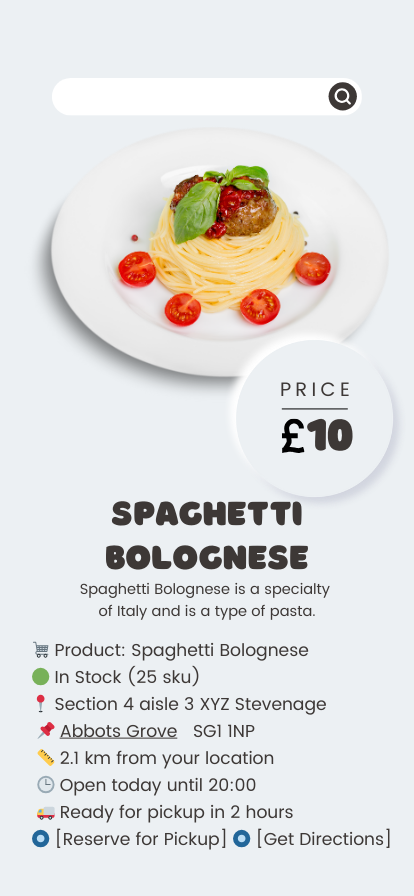
Customer surveys showed in-store shoppers struggled to find products and check stock. I led the launch of a Store Product Locator that used store location to show aisle info, real-time stock levels, and reservation options — reducing product location queries by 35% and improving satisfaction by 12%.
Our task was to improve the in-store shopping experience after surveys revealed customers struggled to locate products and check availability. I led the discovery by analyzing customer feedback, benchmarking competitors , and identifying gaps in our KPIs — including low in-store NPS and frequent staff interruptions. This formed the basis for building a Store Product Locator that used geolocation to show aisle info, real-time stock levels, and reservation options. Post-launch, we saw a 35% drop in location-related queries and a 12% lift in satisfaction scores.
We began with in-store customer surveys and frontline staff interviews, which revealed two consistent friction points:
Customers were unable to locate products easily while in-store
Customers checking from home had no visibility into stock quantity or confidence if it was truly available
To validate this further, we conducted journey mapping, in-store observation, and competitor benchmarking (e.g., Walmart, Target), focusing on how leading grocery retailers addressed real-time in-store product discovery.
Working with analytics, we projected the potential impact on key KPIs, including improvements in:
In-Store Product Search Success Rate (North Star)
Staff assistance request frequency
Same-store conversion rate
I then compiled a formal proposal paper outlining the problem, business case, technical feasibility, and how the solution aligned with our organizational focus on customer autonomy and stakeholder engagement.
The proposal was approved, and we proceeded with development and testing.
We conducted an A/B test across 10 pilot stores, comparing user engagement, staff intervention rates, and conversion against control stores.
The test showed clear positive trends — particularly in product search success and reduced staff dependency.
Following the successful pilot, we launched the Store Product Locator across all stores.
As a result:
Staff assistance requests dropped by 30%
In-Store Product Search Success Rate (our North Star metric) increased by 25%
Same-store conversion rates improved by 12%, especially in high-frequency and high-margin categories
Project SwiftStock - drone-based store replenishment
Situation
Task
Action
Result
The store order replenishment process was highly manual, requiring staff to walk through aisles, visually scan shelves, and create restock orders by hand. This method was slow, error-prone, and inconsistent, resulting in frequent stockouts, inefficient labor usage, and missed sales opportunities.
Goal: Replace manual workflows with a scalable, automated solution to monitor shelf availability and trigger replenishment in real time.
So my tasks ware
- Identify the Problem
- Scope the Challenge
- Conceptualize the Solution
- Build MVP & PoC
- Launch and Iterate
Identified pain points through store shadowing and staff interviews:
Manual order were time-consuming (8–10 hours/store/day)
Frequent stockouts in high-demand SKUs due to late replenishment
Human errors in restock entries led to over/under-stocking
Lack of real-time visibility on shelf availability
Operational inefficiencies due to delayed decision-making
Designed the solution using a lean product discovery approach:
Mapped out user journeys of store staff and replenishment managers
Identified automation opportunities in stock detection, order creation, and approval workflows
Defined MVP focused on top 50 SKUs with high stockout risk and commercial impact
Integrated drone-based scanning with lightweight UI for real-time inventory gap alerts
Ran initial experiments in 3 pilot stores:
Validated feasibility of drone navigation and shelf coverage across diverse layouts
Tested computer vision models for gap detection, achieving 93%+ accuracy
Monitored staff interaction with drone-generated restock suggestions through a dashboard prototype
Convinced C-level and stakeholders by:
Presenting a clear ROI model: 20% reduction in stockouts, 1,200+ labor hours saved/year/region
Sharing real pilot results and side-by-side comparisons with manual processes
Highlighting safety, scalability, and operational compliance based on real store feedback
Addressing concerns around disruption, data accuracy, and change management
Launched and scaled the solution:
Partnered with operations, legal, and IT teams to refine workflows and ensure compliance
Developed onboarding materials and training for store managers
Rolled out to 1,500+ stores, monitored KPI performance, and prioritized roadmap features for v2
Reduced out-of-stock rate by 20%
Saved 1,200+ labor hours per region/year
Achieved 93%+ accuracy in stock gap detection
Increased shelf availability in top SKUs to 98%
North Star KPI
% Shelf Availability of Top-Selling SKUs
Supporting KPIs
Restock Lead Time
Drone Scan Accuracy
Guardrail KPIs
False Positive Trigger Rate
In-Store Operations Disruption
B2B Projects
From Discovery to Delivery: Products That Convert & Retain
Situation
Task
Action
Result
At a B2B grocery retailer we noticed that many B2B customers — especially small business owners like restaurant managers and shopkeepers — were inconsistently reordering essential items, even though they had regular buying patterns.
Customer interviews and support calls revealed three main pain points:
They were too busy running their operations to remember reorder cycles.
They lacked clear visibility into what they ordered last time or how often.
They feared stockouts or last-minute trips, but still forgot to act in time.
This led to a drop in repeat order frequency, increased customer churn, and a rising number of “reactive” support calls asking about previously purchased SKUs.
Our task was to improve B2B customer retention and repeat order frequency, after we observed that many small business customers were not reordering regularly — despite clear, cyclical purchase behavior.
To solve this, I led a structured discovery process:
Identified customer pain points through interviews, surveys, and analysis of support queries
Benchmarked competitor practices to understand how others were nudging reorders and driving engagement
Collaborated with analytics to model the potential KPI impact, including improvements in repeat order rate, AOV, and churn reduction
Created a detailed proposal paper and concept paper, outlining the opportunity, feature design, and strategic alignment
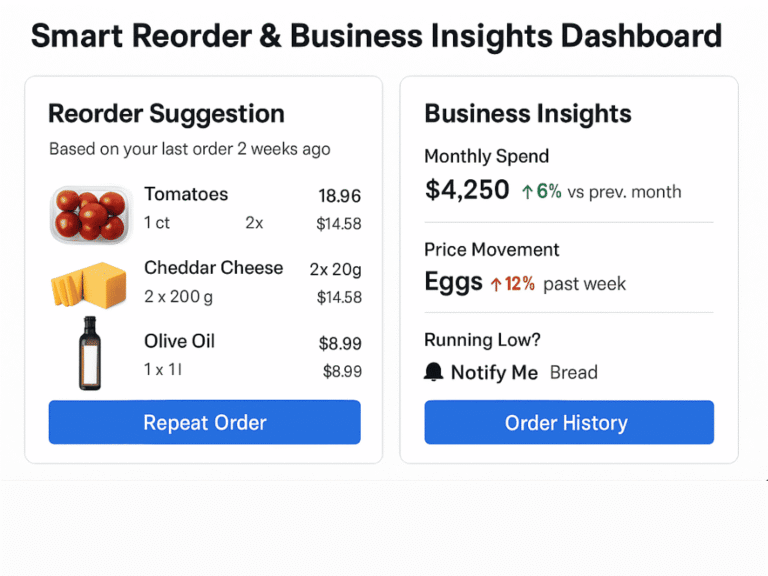
Presented the plan to cross-functional leadership and secured C-level buy-in to build and pilot the Smart Reorder & Insights Dashboard
Ran a structured discovery phase, including customer interviews with small business owners (e.g., restaurants, retailers) to understand day-to-day ordering habits and friction points.
Customers consistently highlighted the challenge of remembering what and when to reorder — and responded positively to the idea of a personalized reorder dashboard showing frequently purchased items, timing cues, and quick repeat options.
Benchmarked against key competitors and found that some already offered similar features, reinforcing the need to close the experience gap.
Collaborated with analytics to model the potential KPI impact, including expected improvements in repeat order rate, average order value, and churn — and the projections were encouraging enough to justify investment.
Used these insights to craft a clear proposal and secure cross-functional and C-level alignment to move forward with development and testing.
The feature was piloted with a targeted segment of B2B customers over a 6-week period.
Our North Star Metric — Average Order Value (AOV) — increased by 9%, driven by larger baskets and higher reorder efficiency.
Supporting metrics showed clear engagement and retention impact:
Repeat orders placed via the dashboard increased by 22%
Clicks within the Business Dashboard increased by 35%, indicating strong usage and discovery
As a guardrail metric, we monitored click-away from dashboard without interaction, which remained low and stable — confirming the feature was not causing confusion or friction.
Based on these outcomes, the feature was rolled out across all eligible B2B customers on web and mobile.